Plan in advance – avoid stress before the 2026 outdoor dining season
The most common mistake before the outdoor dining season is underestimating lead times. Processing police permits, municipal consent/land allocation, any neighbour opinions, supplementary information, and supervisory conditions often take longer than one might expect – especially in attractive locations.
A good rule of thumb for 2026:
- January–February: draw up the area, flows, boundaries, escape routes, and where storage/service stations will be located. Start applications.
- March: secure deliveries of furniture, heating, windbreaks, and branding (signage/lighting).
- April: commissioning, staff training, and fine-tuning guest flows.
The goal is to be “ready in advance” – so you can focus on sales when the weather changes.
The 2026 Permit Checklist – what is usually required (and why)
For most outdoor dining areas in Sweden, the same basic package determines whether you can open on time:
1) Police Permit (public space)
If the outdoor dining area is located in a place considered a public space, a police permit is normally required. This is often where the process starts, and the municipality usually comments on the land allocation.
2) Land Allocation/Municipal Consent
Even when the police are the “permit issuer”, the municipality effectively needs to approve the setup: accessibility, cleaning, waste, snow clearance (for longer seasons), and how the outdoor dining area affects the streetscape.
3) Serving Licence (alcohol) and Boundary
The outdoor dining area needs to be clearly demarcated and included in the area over which you have disposition rights. If you change the area compared to previous years, it may require an update/adjustment to the licence.
4) Food, Hygiene, and Outdoor Handling
If you move operations outdoors (e.g., bar station, simple food preparation, ice cream, serving counter), you need to ensure that routines are maintained even in rain and heat – and that pests and allergen risks are managed.
5) Fire and Evacuation Issues
Gas heaters, electrical wiring, textiles, dense windbreaks, and “tunnel-like” solutions can trigger requirements for placement, distance, and free passage.
6) Music/Sound and Order
Outdoor dining often means a higher sound level. Plan volume, direction, closing routines, and how queuing is managed to reduce the risk of complaints that could affect future conditions.
We help you with the documentation for building permits and police permits
Building an outdoor dining area involves not only practical choices regarding design and materials – it also requires the right permits to be in place. We know that the process surrounding building permits and police permits can feel both complicated and overwhelming. That's why we help our clients produce the correct documentation needed for applications.
We have extensive experience in preparing drawings, documentation, and other papers required by authorities. Whether it's ensuring that the outdoor dining area complies with regulations on fire safety, accessibility, or building codes, we can handle the technical aspects so you can focus on the actual operation and the experience for your guests.
By letting us manage the documentation, you reduce the risk of delays or requests for supplementary information from authorities – which can save both time and money in a project that can otherwise easily become stressful.
Heating that extends the season – and pays for itself
Heating is one of the most profitable upgrades for an outdoor dining area, as it affects what matters most: how long guests stay and how early/late in the season you can fill tables.
A reasonable calculation example (just to get a feel):
If heating and windbreaks allow you to maintain an attractive outdoor dining area for 30 extra days (e.g., in April and September) and you average 20 extra guests per day who would otherwise have chosen not to sit outdoors – with an average bill of SEK 240 – then it becomes:
20 × 240 × 30 = SEK 144,000 in extra turnover.
The key is to choose heating that works in Swedish reality: wind, humidity, and rapid weather changes – and that can be controlled by zone so you don't heat empty areas.
Durable for the Swedish climate – rain, wind, and “mediocre days” are your biggest revenue opportunity
The perfect summer day fills itself. It's all the in-between days that determine the seasonal result.
How to build an outdoor dining area that works when the weather is uncertain:
- Wind zones: create shelter behind the most exposed sides and leave more open towards the sun.
- Flexible rain protection: choose solutions that can be quickly opened/closed and do not feel permanent.
- Drainage and slip resistance: a wet dining surface that feels unsafe discourages impulse purchases.
- Textiles and cushions: invest in materials that can withstand moisture and are easy to bring in/out, otherwise you lose operational efficiency.
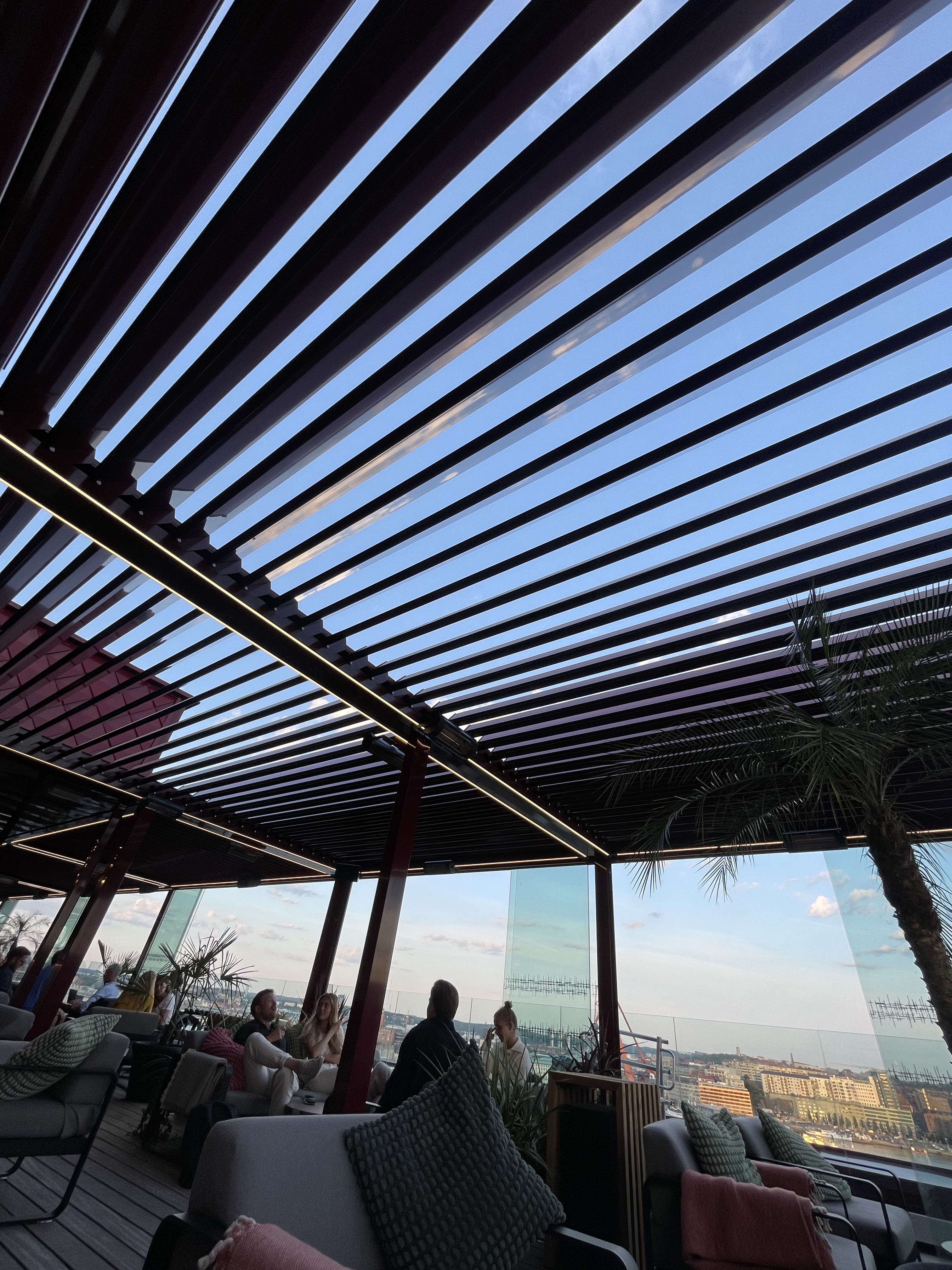
The PS angle here: durable, modular solutions (heating, windbreaks, awnings/pergola-like shelters, and clear branding) allow you to adapt day by day – without having to rebuild each season.
Solutions that last over time – build for 2026, but think 2027–2029
What eats into outdoor dining margins is not procurement – it's wear and tear, manual handling, and unplanned replacements.
Build “for the long term” by prioritising:
- Modular systems (easy to replace one part without replacing everything)
- Service-friendly products (spare parts, standard dimensions, easy assembly)
- Easy winter storage (stackable, wheeled, clear labelling per zone)
- Stable guest experience (the same feeling in April as in July – this drives repeat visits)
And don't forget what is most visible in pictures: lighting, signage, and clear zone demarcation. This helps both spontaneous footfall and makes the outdoor dining area “look open” even when it's a bit colder.
Building permits and regulations affecting 2026 – what's new, and what should you watch out for?
New building permit regulations (effective from 1 December 2025)
For 2026, changes are occurring in building permit regulations which, in many cases, are intended to make it easier to know when a permit is required and when it is not. However, for outdoor dining areas, the core remains the same: if the solution becomes more “building-like” or permanent – the risk of needing a building permit/notification increases.
Practically, this means you should be extra careful with:
- fixed/permanent structures
- roofs perceived as permanent
- fixed walls or glazing
- large wooden decks/platforms that change ground level and accessibility
- installations requiring permanent electricity/fastening
Gothenburg: clear local change in 2026
In Gothenburg, revised guidelines will come into effect on 1 April 2026. They clearly indicate that outdoor dining areas should not be designed as “enclosed rooms” with fixed walls and roofs, as this often conflicts with planning and building legislation and detailed development plans. For you as a restaurateur, this means that 2026 is the year when flexible, open, and season-adapted solutions become extra important – especially if you want to protect guests from rain and wind without getting caught in a building permit process.
Summer pedestrian streets and new areas 2026 – what's happening in Stockholm, Malmö, and Gothenburg?
Here's what's worth keeping an eye on (and using as a business opportunity) for 2026:
Stockholm
- The city continues with summer pedestrian streets and urban environmental zones where car traffic is restricted and where it may be possible to apply for space for outdoor dining even in parking areas (in addition to pavements).
- For summer 2026, it is mentioned, among other things, that the Söder urban environmental zone will be expanded to include part of Östgötagatan.
- There are also recent proposals/reports in the urban environment debate that point out possible new summer pedestrian streets, but the exact list may vary and is usually set closer to the season.
Tip: if you are located near such an area, you can sometimes gain significant footfall – but only if you have your application ready and a quick solution for furnishing, demarcation, and logistics.
Malmö
Malmö is working with “summer streets and squares” where pedestrians are prioritised and where outdoor dining areas may get more space during the season. The city's setup repeatedly includes:
- Kärleksgatan as a summer street (with opportunities for businesses to apply for more outdoor space)
- summer squares that can provide more space for seating and outdoor dining areas
As the setup can be updated from year to year, it's smart to follow decisions and dialogues related to your specific street – especially if you want to expand your area in 2026.
Gothenburg
Gothenburg lists “summer places” where the city creates more space for people, greenery, and in some cases outdoor dining areas. Examples of places that reappear in the city's summer setup are:
- Andra Långgatan (summer pedestrian street)
- Grönsakstorget, Kungsgatan, Kungstorget
- Teatergatan, Stigbergstorget/Allmänna vägen, etc.
For locations in or near summer places, the effect can be clear: more pedestrian traffic, longer dwell times, and more impulse purchases.
Quick checklist for the 2026 outdoor dining season
- Sketch area and flows: entrance, queue, service station, waste, evacuation
- Start permits: police permit/land allocation + update any serving licences
- Check building permit needs early (especially for roofs/walls/glazing/platforms)
- Plan for climate: wind protection + rain protection + zone-controlled heating
- Ensure operation: electricity, cabling, slip risk, cleaning, storage, routines for weather changes
- Review branding: signage, lighting, demarcation – easy to understand and easy to choose